Jeanne Laisne born 1456 was a French heroine known as Jeanne Fourquet and
nicknamed Jeanne Hachette (Jean the Hatchet)
All that she is currently known for is an act of heroism on June 27 1472,
when she prevented the capture of Beauvais by the troops of Charles the Bold,
Duke of Burgundy. The town was defended by only 300 men-at-arms, commanded by
Louis de Balagny.
The Burgundians were making an assault, and one of their members had actually
planted a flag upon the battlements, when Jeanne, axe in hand, flung herself
upon him, hurled him into the moat, tore down the flag, and revived the drooping
courage of the garrison.
From
Wikipedia
click on image to enlarge
Sunday, March 30, 2014
Monday, March 24, 2014
Santa Domingo Pueblo Indian pottery button
This pottery button is stunning also notice the sterling 4 leaf clover and leaf buttons
click on image to enlarge
Saturday, March 8, 2014
Thursday, February 27, 2014
State Seals and Motto's on Buttons
The use of seals was brought to America from
Europe by the colonists. These were the forerunners of the State Seals
today.
Every one of our 50 states has an
official seal and their devices are used by them on the uniform buttons of the
State Militia. The Militia is the oldest service of our armed forces, going back
to the very first year of the colonies.
Most of
the State Seals were adopted in the “Victorian Era”, as a glance at some
elaborate designs will reveal. Many of the states obtained their seals only
after a bitter debate and they can be altered only by law. The state seal
button device came with use some time after the adoption of the
seal.
Six states use the exact state seal device on their
state seal buttons; some alter it somewhat but the seal is still recognizable.
Three states do not use any part of the device of the state seal on their state
seal buttons. They are Wyoming, South Carolina and
Vermont.
Greatly as State Seal buttons differ in appearance, a study
reveals that they have many designs and ideas in common.
16 quality as heraldic—a shield is
the main design
one half show landscapes depicting the surrounding
region,
one half give agriculture a place
one third show means of transportation—trains, covered wagons,
ships, etc.
Just Buttons magazine Mar-Apr 1978
Saturday, February 15, 2014
3 pairs ex. large brass antique pictorial buttons
Bellum and Pax, War and Peace. Bellum was a
Roman adaptation of the Greek warrior goddess, Athena.
She is shown within a border of laurel and
palm, both used to honor those victorious in war.
Pax, or Peace, has a sprig of wheat in her
helmet and an olive wreath border, symbols of agriculture
click on image to enlarge
Friday, February 7, 2014
St. Valentine’s Day legends plus buttons
How did Valentine become the patron saint of
lovers?
According to one legend, in
third-century Rome young men did not want to enlist in the army to fight the
emperor’s wars. Claudius II ordered young men not to marry, believing if they
did not have wives they would be more willing to leave Rome for the battlefield.
Moved by compassion for the young men and their sweethearts, Valentine the
priest married them secretly.
Why do valentine cards end “From Your
Valentine”?
Another legend claims that while
Valentine the priest was imprisoned he met the blind daughter of his jailer. He
offered prayers for her healing, and the girl’s sight was restored. A friendship
was forged. On the night of his death he wrote the girl a farewell message and
signed it “From your Valentine”
How did cupid come to be associated with St.
Valentine’s Day Cards?
Cupid, represented by a cherub armed
with arrows dipped in a love potion, is a figure of Roman mythology. According
to those legends, Cupid is the son of Venus, goddess of love and
beauty.
Click on picture to enlarge
Happy Valentine's Day
Saturday, January 11, 2014
Sunday, January 5, 2014
Saturday, December 28, 2013
Vanity Set metal, early goofie buttons
This is one
of the oldest sets of goofies, possibly as early as 1930, made of metal and
painted
mirror,
perfume atomizer, crossed nail buffer and scissors, crossed comb and brush,
powder box, compact and lipstick
click on image to enlarge
Wednesday, December 25, 2013
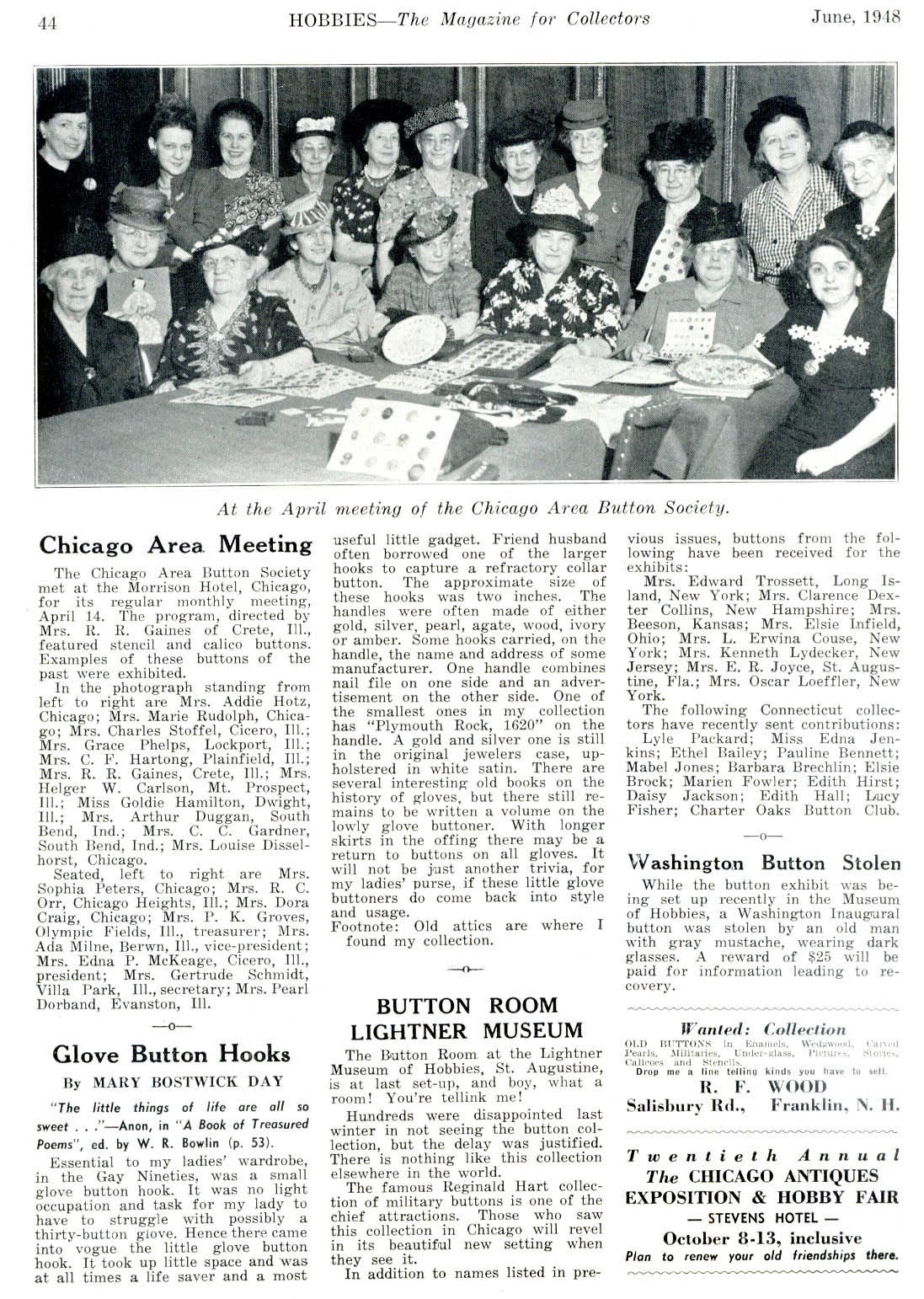
Button Collectors 1948
The
National Button Society was formed in 1938
This
article on early collectors was in Hobbies Magazine 1948click on image to enlarge
Thursday, December 19, 2013
Christmas buttons
Card 3 of my fun cards of Christmas buttons
Materials: wood, plastic, metal, enameled brass, ceramic
Click on image to enlarge
Materials: wood, plastic, metal, enameled brass, ceramic
Click on image to enlarge
Wednesday, December 11, 2013
Christmas buttons
Card 2 of my fun cards of Christmas buttons
Materials: Plastic, enameled brass, fabric, ceramic, rubber
Click on image to enlarge
Materials: Plastic, enameled brass, fabric, ceramic, rubber
Click on image to enlarge
Thursday, December 5, 2013
Christmas buttons
Card 1 of my fun cards of Christmas buttons
Materials:ceramic, wood, glass, brass, enameled brass and plastic
click on image to enlarge
Materials:ceramic, wood, glass, brass, enameled brass and plastic
click on image to enlarge
Wednesday, November 20, 2013
Friday, November 8, 2013
Containers with Fruits and/or Flowers BUTTONS
The
buttons are antique and vintage
Click on image to enlarge
Sunday, October 27, 2013
Sunday, October 13, 2013
Victorian white glass buttons 1840’s to early 1900’s
Victorian white
glass buttons 1840’s to early 1900’s
On this card they are all opaque white buttons
Among glass
buttons the term Victorian is used specifically for those of opaque (or more
rarely, transparent) white or colored glass with conventional and floral designs
molded in low relief or incised, with paint or luster trim. They typically have
four-way or two way metal box shanks.
Pictures
other than floral types are unusual. Many have designs of Art Nouveau
influence
Click on image to enlarge
Tuesday, October 8, 2013
Victorian color glass buttons 1840’s to early 1900’s
Among glass
buttons the term Victorian is used specifically for those of opaque (or more
rarely, transparent) white or colored glass with conventional and floral designs
molded in low relief or incised, with paint or luster trim. They typically have
four-way or two way metal box shanks.
Pictures
other than floral types are unusual. Many have designs of Art Nouveau
influenceClick on image to enlarge
Thursday, September 26, 2013
Wednesday, September 18, 2013
18th century mother of pearl button
18th
century mother of pearl button
carved with a jeweled pin shank
shank: the “eye” is of flat copper wire and there is a tinned copper collet at the back
Wednesday, September 11, 2013
Saturday, August 31, 2013
Stork, pearl and brass button
A finely
detailed, stamped, silvered and pierced design mounted over a carved and pierced
pearl background. There is a second bird carved into the pearl background,
at right. The steel-set, brass rim is applied over the pearl background.
Wednesday, August 28, 2013
Sunday, August 18, 2013
Saturday, August 10, 2013
Sunday, July 21, 2013
Moonglow glass buttons
Made by a special process from a cane with both clear and opaque, translucent glass throughout its length. When heated and pressed into a mold, it becomes a moonglow if the clear colorless glass “floats” to the top of the button.
Tuesday, July 2, 2013
Happy 4th of July.. buttons
Some of my fun red/white and blue buttons
One of the cards show some with a green color they are not all are red,white and blue
Saturday, June 8, 2013
Mermaid buttons
There are many versions of the Legends of Lorelei which originated in Germany
Lorelei is the name of a spirit and the big rock in the Rhine River on which she sits. Lorelei, the most famous of the Rhine Maidens, is a Siren like mermaid who sits on her rock in the Rhine, combing her long hair and singing.
the poor photo is my feeble attempt from the deck of the cruise ship
Saturday, May 25, 2013
Sunday, May 19, 2013
Rose flower buttons
First is brass wild rose 2nd looks like porcelain on brass and last is white metal
these are available in my ecrater button store under the plant life category, pegsbuttons.ecrater.com
Saturday, May 11, 2013
Friday, April 26, 2013
Pansies and Violets..buttons
April
showers bring May flowers
here is my
card I entered in a button show several years ago “Pansies and Violets” I have
many different materials and thought my card was worthy of a ribbon..but instead
I received a “measle” because in the third row 2nd button (which in the Big Book
of Buttons states it’s a pansy) is actually a Hibiscus.
Saturday, April 6, 2013
Brooks buttons
These are small plastic
buttons designed and painted by Edith and Alan Brooks in England
Edith and Alan opened a “craft-workers” private business. Without advertising but through maintaining a high standard of workmanship, the Brooks gained recognition and sent buttons to many parts of the world. They had no interest in mass production. Just the 2 of them worked at a large table facing each other the design was applied using a fine sable brush “with points like needles” they painted the design straight on the button. They worked on six buttons at a time, sewed onto a card by Edith, Dab-dab-dab all the way down and then dab-dab-dab again all the way down-the same dab on each button. Thus the design grew
When American collectors became aware of the Brooks buttons they were imported from England in the 1960’s and 70’s
Edith and Alan opened a “craft-workers” private business. Without advertising but through maintaining a high standard of workmanship, the Brooks gained recognition and sent buttons to many parts of the world. They had no interest in mass production. Just the 2 of them worked at a large table facing each other the design was applied using a fine sable brush “with points like needles” they painted the design straight on the button. They worked on six buttons at a time, sewed onto a card by Edith, Dab-dab-dab all the way down and then dab-dab-dab again all the way down-the same dab on each button. Thus the design grew
When American collectors became aware of the Brooks buttons they were imported from England in the 1960’s and 70’s
The Brooks didn’t just paint buttons they both taught embroidery at college, they
sold their embroidery items, comb cases, spectacle cases and needle cases, they
also made brooches, penchants and earrings. Brooches were painted similar to
their buttons with tiny spangles sometimes embedded in the design. They made
delicate flower groups on mother of pearl to fit into antique brooches to
replace faded photographs of long dead relatives. Their items were decorated in
enamels on mother of pearl, wood, plastics and various other materials, but the
Brooks buttons are most sought after.
Both Edith and Alan
Brooks have passed
away, information about them
and the buttons can be found in National Button Society bulletins: February
1973, May and October 1989, December 1990 and December 1993 Just Buttons
magazine June 1964 and November 1964 also see Carol C.'s wonderful Brooks study pages at
CLICK ON IMAGE TO ENLARGE
Wednesday, March 27, 2013
Easter Parade button
Antique
brass button, a gnome pulls an eggshell cart, notice the rabbit peering over the
hill.
Happy Easter!
Friday, March 22, 2013
National Broadcasting Company buttons
Formed in 1926 by the Radio Corporation of
America (RCA), NBC is the oldest broadcasting network in the U.S.
Both brass uniform buttons are old the first has radio waves
in the ether, a microphone with the initials N B C
these are not for sale but I do have one like
the first listed on ebay at this time..it ends in 5 days (SOLD)
ebay: purple-peg
Saturday, March 9, 2013
Monday, February 25, 2013
Thursday, February 7, 2013
Chinese Dragon Slayer button
Tuesday, January 15, 2013
Coralene glass button
Coralene: Buttons decorated with tiny glass beads heat fused to the surface. Most have
4-way metal shanks and are considered to be of the middle to late 19th century (Victorian period). Some have only one color added and a rim of gold luster added while others have floral designs.
My button is a lady’s head and does have the 4-way metal shank
Sunday, December 30, 2012
Saturday, December 15, 2012
Rock crystal buttons
Rock crystal buttons are scarce. These small silver-mounted buttons, with red foil underneath the faceted rock crystal stone, were worn on a man’s breeches in the early-eighteenth century (Many collectors think that this type of button may actually date from the 1600’s